
What it does
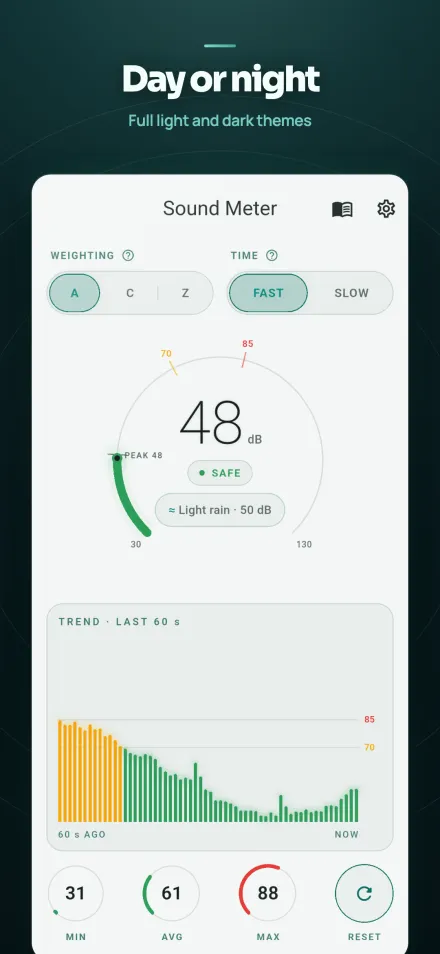
Open the app and it starts measuring right away. A circular ring gauge shows the current sound level in decibels, updating in real time as the room gets louder or quieter. Color zones mark the reading as quiet, moderate, or loud, so the number means something at a glance.
Below the gauge, a trend chart shows one bar per second for the last 30 seconds, 60 seconds or 5 minutes, so you see a pattern instead of a single digit. A small chip compares your reading with an everyday sound, like a quiet room or a passing truck. The app also tracks Min, Max, and an energy-based average (Leq) for the current session, with a one-tap reset.
Sessions of 5 seconds or longer can be saved on your phone with their full graph, a note and a place, and exported as a CSV file. If you turn on the optional audio clip, the sound is recorded with the session so you can play it back; the clip is off by default and stays on your phone.
Screenshots
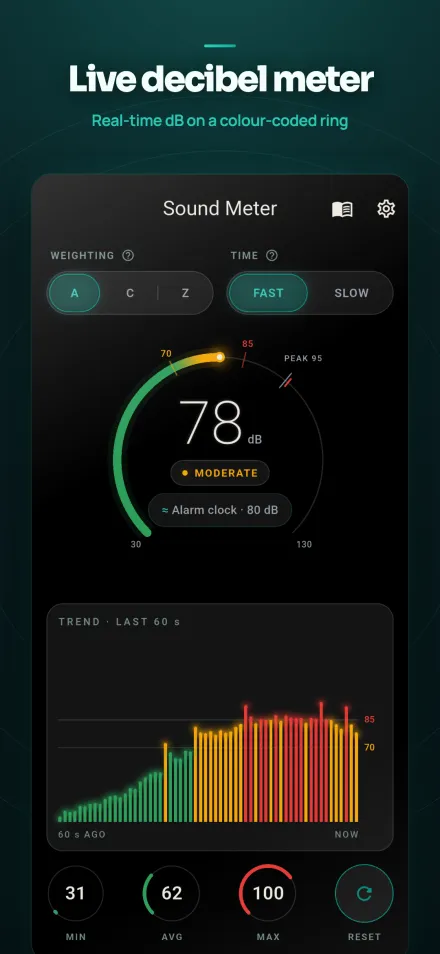
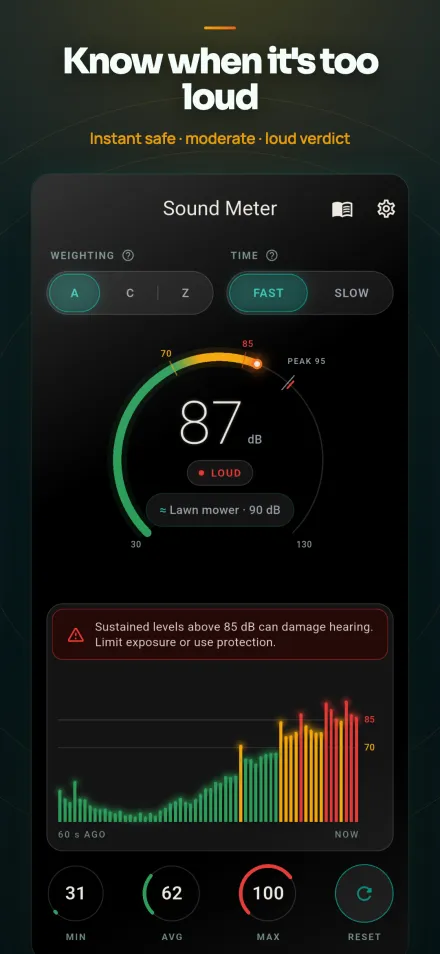
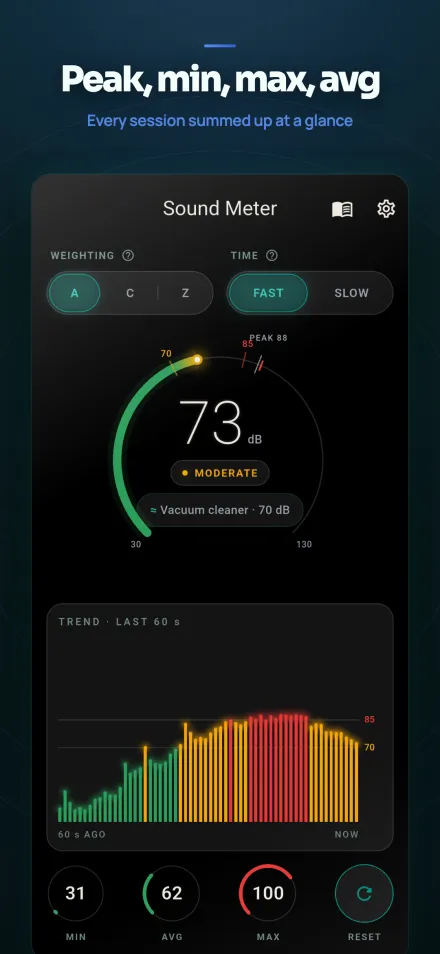
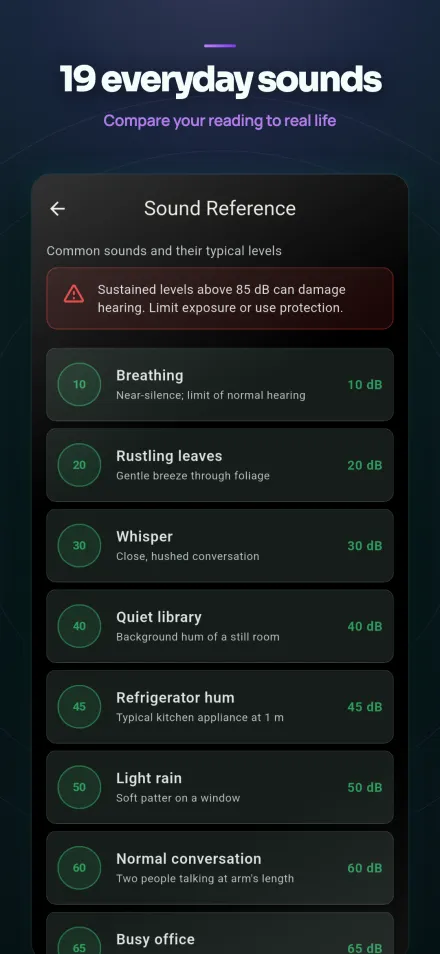
Features
- Live decibel gaugeA ring gauge shows the current sound level in dB, updated continuously from the phone's microphone.
- A, C and Z weightingA weighting follows human hearing, C suits low-frequency sound, and Z is unweighted. A and C use real per-frequency IEC 61672 filters on the current release.
- Fast and Slow responseTwo time-response modes use real exponential time averaging, matching standard noise-measurement convention.
- Session statsThe app tracks Min, Max, and an Leq-style average for the current session, with a one-tap reset.
- Trend chartA bar chart shows one bar per second for the last 30 seconds, 60 seconds or 5 minutes, so you can see the pattern over time.
- Timed measurementMeasure for 10, 30, or 60 seconds and get a single LAeq result for that period.
- Calibration sliderAn offset of up to ±20 dB lets you compensate for differences between phone microphones.
- Sound reference guideA built-in list of 19 everyday sounds, such as a whisper at 30 dB and a rock concert at 110 dB, for comparison.
- Saved sessions and CSV exportKeep a session with its full graph, a note and a place, then export it as a CSV file through your phone's share sheet.
- Optional audio clipOff by default. When you turn it on, a clip of the sound is saved with each session, only on your phone, and is deleted when you delete the session.
- Noise alert and classroom lightSet a level and get an alert when the sound passes it (the app must stay open with the screen on), plus a full-screen classroom traffic light.
- Frequency analyzer and noise doseSee the dominant frequency and the spectrum, plus a noise-dose estimate. Both are phone-microphone estimates, not certified instruments.
- Photo with the readingTake a photo with the current dB reading stamped on it. It is kept in the app, and on Android 10 and newer you can save a copy to your gallery. You can also share a result card, add a home-screen widget, or open the meter from a Quick Settings tile.
- 16 languagesEnglish, Arabic, French, German, Hindi, Indonesian, Italian, Japanese, Korean, Polish, Portuguese, Russian, Spanish, Thai, Turkish and Urdu. Change the language in Settings.
How it works
Sound Meter uses the phone's microphone to measure the ambient sound level, and the level is calculated on the device in real time. Nothing is recorded unless you switch on the optional audio clip (it is off by default); a clip is kept only on your phone, with its session, and is never uploaded.
Measurement runs fully offline, so no internet connection is needed to take a reading. The calibration slider lets you nudge the result to account for your specific phone's microphone.
Limits
- Sound Meter is a screening tool for everyday awareness and education. It does not meet the Type 1 or Type 2 certified-instrument standard for sound level meters.
- Readings vary by phone microphone, case, and calibration. Use the calibration slider to get closer to an accurate baseline for your device.
- For occupational reporting or legal evidence, use a calibrated, certified instrument instead.
- The noise alert works only while the app is open and the screen is on.
- The app needs microphone permission to take a measurement; without it, the meter cannot read sound levels.
Privacy
Sound Meter collects no personal data and shows no ads in the current version.
If a future update adds advertising, the privacy policy will be updated first, with full disclosure, and EEA/UK users will see a consent request before any ads appear.
The app makes no network requests, so Ardesse never receives your measurements, clips or photos. Saved sessions, audio clips and photos stay on your phone until you delete them or uninstall the app, and the app's copies of clips and photos are left out of Android backups. A photo you save to the gallery becomes an ordinary picture on your phone, and you can share a CSV file or a photo yourself through your phone's share sheet.
Read the full Sound Meter privacy policy
Questions
Does Sound Meter record my audio?
Only if you turn on the optional audio clip, which is off by default. The clip is saved with its session on your phone only, is never uploaded, and is deleted when you delete the session. Otherwise the microphone is used only to calculate the level.
Is this as accurate as a professional sound level meter?
No. It is a screening tool, and phone microphones are not lab instruments. Use the calibration slider and treat readings as estimates.
Does the app need an internet connection?
No. It works fully offline, and all measurement happens on the device.
Are there ads?
Not in the current version. The app shows no ads today, and any future change would come with an updated privacy policy and clear notice.
Google Play and the Google Play logo are trademarks of Google LLC.